The modernization of the Department of Veterans Affairs (VA) disability claims process has transformed the landscape of appellate advocacy for veterans seeking compensation for service-connected disabilities. Following the implementation of the Appeals Modernization Act (AMA) in 2019, the legacy appeals system was replaced with a highly structured, multi-tiered framework designed to offer distinct procedural lanes. While this architecture ostensibly streamlines the adjudication of benefits, it concurrently places a rigorous evidentiary, administrative, and strategic burden on claimants. The volume of claims navigating this system is staggering; recent data indicates that the Board of Veterans' Appeals (BVA) alone manages an inventory of tens of thousands of appeals, with total appealed claims across the Veterans Benefits Administration (VBA) approaching historically high volumes in the hundreds of thousands.
Navigating an adverse VA claim result requires an exhaustive understanding of statutory deadlines, evidentiary thresholds, and the fundamental differences between administrative adjudication at the VBA, quasi-judicial review at the BVA, and adversarial litigation at the United States Court of Appeals for Veterans Claims (CAVC). Choosing the correct appellate path, securing the appropriate evidence, and adhering to strict statutory timelines are paramount to preserving effective dates and securing retroactive compensation. This report provides a comprehensive analysis of the appellate pathways available following an adverse VA claim result, detailing the evidentiary burdens, strategic evidence acquisition, the role of legal representation, and the procedural escalation of a claim through the federal judiciary.
Foundational Prerequisites: Analyzing the Denial and Securing the Claims File
Before any appeal is initiated, a forensic review of the adverse decision must be executed to determine the precise legal or factual basis for the denial. The VA disability compensation system requires three fundamental elements for service connection: a current medical diagnosis, an in-service event or injury, and a medical nexus linking the current disability to the in-service event. (Those three elements, and the evidence each one requires, are treated at length in Service Connection: The Three Things VA Requires; where a prior denial rested on a toxic-exposure theory that the law has since changed, see what the VA budget says about refiling a pre-PACT Act denial.) An adverse rating decision typically results from the failure to satisfy one or more of these elements, or from a medical examiner's determination that a condition is less likely than not related to military service.
The Centrality of the C-File and the FOIA Process
The most critical asset in formulating an appellate strategy is the veteran's Claims File, commonly referred to as the C-File. The C-File serves as the master repository for all records the VA utilized in adjudicating the claim, including service treatment records (STRs), prior rating decisions, independent medical opinions, and Compensation and Pension (C&P) examination reports, frequently referred to as Disability Benefits Questionnaires or DBQs. Without reviewing the comprehensive C-File, a claimant operates with a severe informational deficit, making it nearly impossible to ascertain whether the VA rater ignored highly probative evidence or if a C&P examiner was provided an incomplete medical history.
To acquire the C-File, a claimant or their authorized representative must submit a Freedom of Information Act (FOIA) or Privacy Act request using VA Form 20-10206. This form allows veterans to officially request their complete military and VA history, including official military personnel files (OMPF), pension benefit documents, and specific clinical exams. The request must be properly certified, requiring handwritten or approved digital signatures, alongside identifying data such as the veteran's Social Security Number or VA File Number. The completed request is typically submitted to the VA Evidence Intake Center in Janesville, Wisconsin, via mail, toll-free fax, or VA's online records request tool.
The acquisition of these records requires strategic patience. Three to six months is the hope, not the expectation. VA publishes no target turnaround for producing a complete C-File, and production is slowed by the volume of requests processed by the Evidence Intake Center and the logistical challenges associated with retrieving older, physical records from the National Archives. What VA does publish is its annual FOIA report; in fiscal year 2024 the Veterans Benefits Administration averaged 47.47 working days on simple requests and 48.82 working days on complex requests, while processing 97,415 of VA's 119,453 total FOIA requests. Full C-File production routinely exceeds those averages, and a request that runs for years is not an anomaly.
Work this step interactively: Phase 1: Know What Denied You in the VA Appeals Navigator.
Identifying Evidentiary Deficits and Procedural Errors
Once the C-File is obtained, an analysis must be conducted to identify errors in the VA's initial adjudication. A primary focus must be the exam request document generated by the Veterans Service Representative (VSR). The VSR is tasked with compiling all relevant evidence from the veteran's file and forwarding it to the contract medical examiner. If the C-File reveals that the VSR failed to include critical STRs, lay statements, or private medical records in the exam request, the subsequent medical opinion is inherently flawed due to an incomplete factual premise. This specific procedural failure constitutes a Duty to Assist error, which serves as the foundational argument for pursuing a Higher-Level Review.
Conversely, if the C-File demonstrates that the examiner possessed all relevant evidence but provided a well-reasoned medical rationale against service connection, the claimant is facing a deficit in probative medical evidence. This scenario necessitates the acquisition of new and relevant evidence and the filing of a Supplemental Claim, effectively forcing the VA to re-evaluate the claim in light of newly submitted clinical or lay testimony.
Evidentiary Standards and Regulatory Nuances
Understanding the specific legal standards governing the evaluation of evidence is critical for formulating an appeal. The VA operates under a unique, non-adversarial administrative system that is ostensibly designed to be pro-veteran, although the practical application of this standard frequently requires aggressive appellate enforcement.
The Benefit of the Doubt Doctrine
A cornerstone of veterans law is the Benefit of the Doubt doctrine, codified at 38 U.S.C. 5107(b) and implemented through 38 CFR 3.102. This statutory provision mandates that when there is an approximate balance of positive and negative evidence regarding any material issue, a state known in legal terms as equipoise, the VA must resolve the doubt in favor of the veteran. If a claimant submits a private medical nexus opinion that is equally as persuasive and detailed as a negative VA contract examiner's opinion, the legal standard of equipoise dictates that the claim should be granted. However, raters frequently fail to correctly apply this doctrine, necessitating an appeal to force adherence to the evidentiary standard.
The Impact of Medication on Functional Impairment Evaluations
When developing medical evidence for an appeal, claimants and their medical experts must be acutely aware of how the VA evaluates functional impairment, particularly concerning the ameliorative effects of medication. The regulatory landscape surrounding 38 CFR 4.10 recently experienced significant upheaval. In the landmark case Ingram v. Collins, No. 23-1798 (Vet. App. Mar. 12, 2025), the federal court determined that the VA generally cannot base a disability rating on how well a veteran functions while medicated, unless the specific diagnostic code explicitly factors in treatment response. This ruling mandated that examiners evaluate the underlying severity of the disease absent the masking effects of pharmacology. Ingram extended to the musculoskeletal diagnostic codes a principle the Court had already established in Jones v. Shinseki, 26 Vet. App. 56 (2012), and McCarroll v. McDonald, 28 Vet. App. 267 (2016) (en banc); its holding is that "because the applicable diagnostic codes and special musculoskeletal regulations do not reference medication, the Board must discount beneficial medication effects when assigning an evaluation."
In early 2026, the VA issued a highly controversial interim final rule, "Evaluative Rating: Impact of Medication," 91 Fed. Reg. 7118 (Feb. 17, 2026), which took effect immediately on publication and displaced the Ingram precedent, VA arguing that the court's interpretation would overburden the system and mandate the readjudication of over 350,000 claims across 500 diagnostic codes. This interim rule instructed raters to evaluate veterans based on their present level of functioning with medication in place, providing that "if medication or other treatment lowers the level of disability, the rating will be based on that lowered disability level," effectively penalizing veterans for treatment compliance. The rule drew immediate and intense backlash from veterans service organizations and advocacy groups, who argued it created a dangerous incentive for veterans to abandon necessary medications prior to examinations to demonstrate their true level of impairment.
The VA rescinded the interim rule a mere ten days after its publication, 91 Fed. Reg. 9712 (Feb. 27, 2026), "restoring the prior regulatory text" and citing an ongoing court action it did not name. Consequently, the framework established by Ingram v. Collins remains the controlling legal standard. Therefore, when securing private medical opinions or preparing for a new C&P examination on appeal, it is imperative that medical experts thoroughly document the veteran's functional limitations, the frequency of flare-ups, and the severity of the underlying condition, explicitly noting the impairment that would exist without medication, as well as the side effects of the medications themselves.
The Appeals Modernization Act Pathways at the Agency of Original Jurisdiction
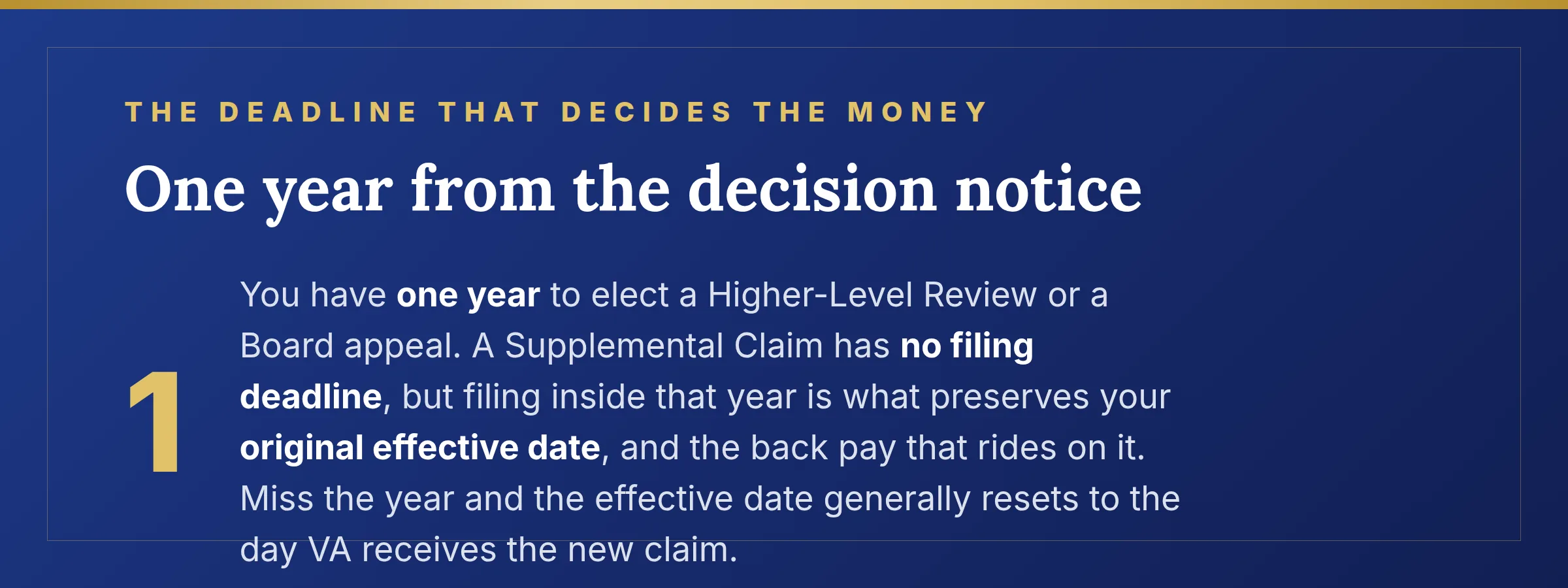
Under the AMA framework, claimants have exactly one year from the date of the adverse decision letter to file an appeal in one of two distinct lanes, a Higher-Level Review or a Board Appeal, with the Supplemental Claim available as a third option that carries no filing deadline of its own. Adherence to this one-year deadline is a critical statutory requirement. Filing within this timeframe constitutes continuous pursuit of the claim, which preserves the original effective date and ensures the continued accrual of retroactive back pay while the appeal is pending. If the one-year deadline expires, the decision becomes final, and while the claimant may still file a Supplemental Claim at any time, the effective date will generally reset to the date the new claim is filed, resulting in a forfeiture of historical compensation. The election deadline and the continuous-pursuit rule are codified at 38 CFR 3.2500, and the effective-date consequence at 38 U.S.C. 5110(a)(2) and (a)(3).
| AMA Appeal Lane | Primary Function | Evidentiary Rule | Average Timeline |
|---|---|---|---|
| Supplemental Claim | Overcome medical or factual denials. | Requires "new and relevant" evidence. | VA goal 125 days |
| Higher-Level Review | Correct legal, factual, or procedural errors. | Closed record; no new evidence permitted. | VA goal 125 days |
| Board Appeal (BVA) | Resolve complex legal disputes or weigh highly conflicting evidence. | Depends on the selected BVA docket. | VA goal 365 to 730 days by docket |
Work this step interactively: Phase 2: Compare the three lanes side by side in the VA Appeals Navigator.
Those timelines are VA's own published goals, set out on its decision review comparison page. Actual performance varies by lane and by reporting period.
The Supplemental Claim Lane
The volume of Supplemental Claims has surged dramatically under the AMA, growing from approximately 50,102 in fiscal year 2019 to over 685,669 in fiscal year 2025, according to VA's monthly Appeals Modernization Act metrics reports. Supplemental Claims are now the larger share of the VBA's pending workload, 63 percent of a pending inventory of 611,453 claims, against a backlog cut to 70,529 (Characteristics of Claims, updated monthly).
The threshold for what constitutes new and relevant evidence is relatively low, acting as a gateway to reopen the claim. New evidence means information not previously of record at the time of the prior final decision, while relevant evidence is that which tends to prove or disprove a matter at issue in the claim. If a claim was previously denied because the veteran lacked a current medical diagnosis, submitting a newly acquired medical record containing that diagnosis satisfies the evidentiary threshold to reopen the claim.
However, merely reopening the claim does not guarantee a grant of benefits. The substantive burden requires that the new evidence, when weighed against the existing negative evidence, tips the evidentiary scale in the veteran's favor to achieve at least equipoise. If a previous C&P examiner provided a negative nexus opinion, the veteran must introduce a new, highly probative private medical opinion that accounts for the prior examiner's rationale and systematically dismantles it using superior medical literature and a more thorough review of the veteran's clinical history.
A significant strategic hazard inherent in the Supplemental Claim process is the premature filing of subsequent claims without adequate evidentiary development. When a claimant repeatedly files Supplemental Claims using weak or redundant evidence, the VA will continually deny the claim, often ordering new C&P examinations that generate additional negative medical opinions. This phenomenon, known as stacking negative evidence, severely damages the long-term viability of the claim. If a veteran accumulates three separate negative VA medical opinions across multiple haphazard appeals, a single private medical opinion submitted years later will struggle to overcome the sheer volume of negative precedent in the file.
The Higher-Level Review Lane
The Higher-Level Review (HLR), initiated via VA Form 20-0996, is a closed-record, de novo review conducted by a senior adjudicator known as a Decision Review Officer. Because the evidentiary record is strictly closed, the claimant is prohibited from submitting any new documents, medical records, or lay statements. The HLR is a mechanism designed exclusively to identify and correct errors of law or fact made by the lower-level adjudicator based solely on the evidence that was available at the time of the initial decision. Data indicates that the HLR lane is highly efficient when utilized correctly, with the VA frequently achieving its 125-day processing target, and the overall grant rate steadily climbing from 14.5% in 2019 to 24.2% in 2025 (VA AMA metrics reports).
An HLR is highly effective when the evidence of record clearly supports a grant of benefits, but the VA rater misapplied the M21-1 Adjudication Procedures Manual, overlooked existing evidence, or failed to fulfill the VA's statutory Duty to Assist. Claimants have the right to request an Informal Conference, which is a telephonic hearing with the Decision Review Officer. During this conference, the veteran or their representative can pinpoint the exact procedural or factual error, citing specific pages within the C-File and referencing the applicable regulatory provisions.
The Decision Review Officer has two primary mechanisms for resolving an HLR in the claimant's favor. The first is a Difference of Opinion. If the DRO reviews the existing evidence and determines that the lower-level rater's conclusion was factually incorrect or that the evidence sat in equipoise, the DRO possesses the authority to unilaterally overturn the decision and grant the benefit directly.
The second, and far more common mechanism, is the declaration of a Duty to Assist error. The DRO will frequently identify a developmental failure, such as the VSR omitting relevant STRs from the exam request, or relying on an inadequate C&P examination that failed to provide a legally sufficient rationale. When a Duty to Assist error is declared, the HLR is administratively closed, and the claim is converted into a new Supplemental Claim to correct the specific error. The VA will then undertake directed development, which typically involves ordering a new C&P examination or an Acceptable Clinical Evidence (ACE) review. Crucially, once a Duty to Assist error converts the claim, the closed-record restriction is lifted. Claimants are strongly advised to submit all pertinent evidence directly to the newly opened claim to ensure the new examiner has a comprehensive and accurate clinical picture.
The Board of Veterans' Appeals
When resolution cannot be achieved at the Agency of Original Jurisdiction, or when a claim involves highly complex statutory interpretations that exceed the scope of the M21-1 manual, the claimant may appeal directly to the Board of Veterans' Appeals. The BVA is staffed by Veterans Law Judges (VLJs) who operate in Washington, D.C., and review appeals de novo.
A critical distinction must be drawn between the adjudicatory philosophy of the VBA and the BVA. The VBA operates strictly within the confines of the M21-1 manual, which serves as internal operating procedures but lacks the force of law. VSRs and rating personnel generally do not interpret raw statutes or precedential case law. Conversely, the BVA is a quasi-judicial body legally bound by the regulations of the Department, the instructions of the Secretary, and the precedent opinions of the chief legal officer. The BVA applies raw statutory law (Title 38 of the United States Code) and regulatory law (Title 38 of the Code of Federal Regulations) to the facts of the case, making it the appropriate venue for legal arguments, constitutional due process claims, and complex appellate strategy.
Selecting the Appropriate BVA Docket
To initiate a BVA appeal, the claimant files VA Form 10182 within one year of the adverse decision. The AMA requires the claimant to select one of three procedural dockets, each carrying distinct evidentiary rules and vastly different processing timelines.
| BVA Docket | New Evidence Allowed? | Hearing Provided? | Average Days to Complete (FY2024) | Average Days Pending (Mar. 2026) |
|---|---|---|---|---|
| Direct Review Fastest |
No | No | 937 | 212 |
| Evidence Submission Middle |
Yes (within 90 days) | No | 1,028 | 260 |
| Hearing Docket Slowest by far |
Yes (at hearing or 90 days after) | Yes (Virtual or In-Person) | 1,091 | 870 |
The first figure is how long appeals decided in fiscal year 2024 actually took, from the Chairman's FY2024 Annual Report to Congress. The second is how long appeals currently sitting in the queue have been waiting, from the Board's decision wait times data.
The Direct Review docket is the most expeditious route at the BVA. The claimant requests that a VLJ review the case based solely on the evidence that was before the VBA at the time of the decision, without any new evidence or a hearing. This docket is strategically optimal when the record is fully developed, the evidence sits in equipoise, and the VBA simply misapplied the law.
The Evidence Submission docket permits the claimant to submit new documentary evidence, provided it is submitted within 90 days of filing the Notice of Disagreement. This lane is highly effective when the claimant has recently acquired a dispositive private medical opinion that was not reviewed by the VBA, but does not require the logistical delay of scheduling a formal hearing.
The Hearing Docket allows the veteran to present oral testimony directly to a Veterans Law Judge. While this provides an opportunity for the judge to assess the veteran's credibility firsthand, the logistical constraints and massive administrative backlogs make this docket the slowest, routinely taking years to yield a decision. A significant percentage of cases on the hearing docket ultimately end in administrative closures, dismissals, or hearing cancellations, further complicating the statistical viability of this route.
The Statutory Mandate for Adequate Reasons and Bases
A defining feature of BVA jurisprudence is the strict statutory mandate outlined in 38 U.S.C. § 7104(d)(1). This statute requires that each Board decision include a written statement of the Board's findings and conclusions, accompanied by the specific reasons or bases for those findings on all material issues of fact and law presented on the record.
The reasons and bases requirement is the cornerstone of due process within the VA appellate system. A VLJ cannot simply adopt a negative C&P examiner's opinion without providing a thorough, logical explanation of exactly why that opinion was deemed more probative than the claimant's private medical evidence. The BVA must explicitly reconcile conflicting evidence, explain its evaluation of the credibility of lay statements, and articulate the specific legal standard applied. Furthermore, the BVA is constrained by constitutional due process, which dictates adequate notice, the right to present evidence, and the right to an unbiased decision-maker, principles affirmed by the Federal Circuit in cases such as Cushman v. Shinseki, 576 F.3d 1290 (Fed. Cir. 2009). Failure to provide adequate reasons and bases effectively shields the BVA's logic from subsequent judicial review, and it remains the single most common reason that BVA decisions are vacated and remanded by the federal courts.
Internal Quality Assurance and Reconsideration Mechanisms
The BVA's internal quality and consistency have been the subject of significant scrutiny. Government Accountability Office (GAO) reports highlight the necessity for the BVA to establish rigorous Standard Operating Procedures (SOPs) for calculating quality assurance rates and tracking the root causes of errors that result in federal court remands (see GAO-24-106156, issued November 2023). The Board utilizes monthly reports to track decisions remanded by the CAVC, and has implemented automated systems to return remanded appeals directly to the VLJ who originally signed the decision, forcing accountability and readjudication by the original author.
If a BVA decision contains a catastrophic error, the claimant is not immediately forced into federal court. Under 38 CFR 20.1000 and 20.1001, the Board retains the authority to vacate or reconsider its own decisions. A decision may be vacated upon a showing of a severe denial of due process, such as the failure to honor a hearing request or the prejudicial denial of the right to representation. Furthermore, reconsideration may be granted upon the allegation of an obvious error of fact or law, upon the discovery of new evidence in the form of relevant service department records, or if the prior allowance of benefits was materially influenced by false or fraudulent evidence. Practitioners working from pre-2019 authority should note that these provisions were renumbered when the AMA regulations took effect: vacatur was formerly 38 CFR 20.904, which today is an unrelated rule governing remand and referral.
The United States Court of Appeals for Veterans Claims
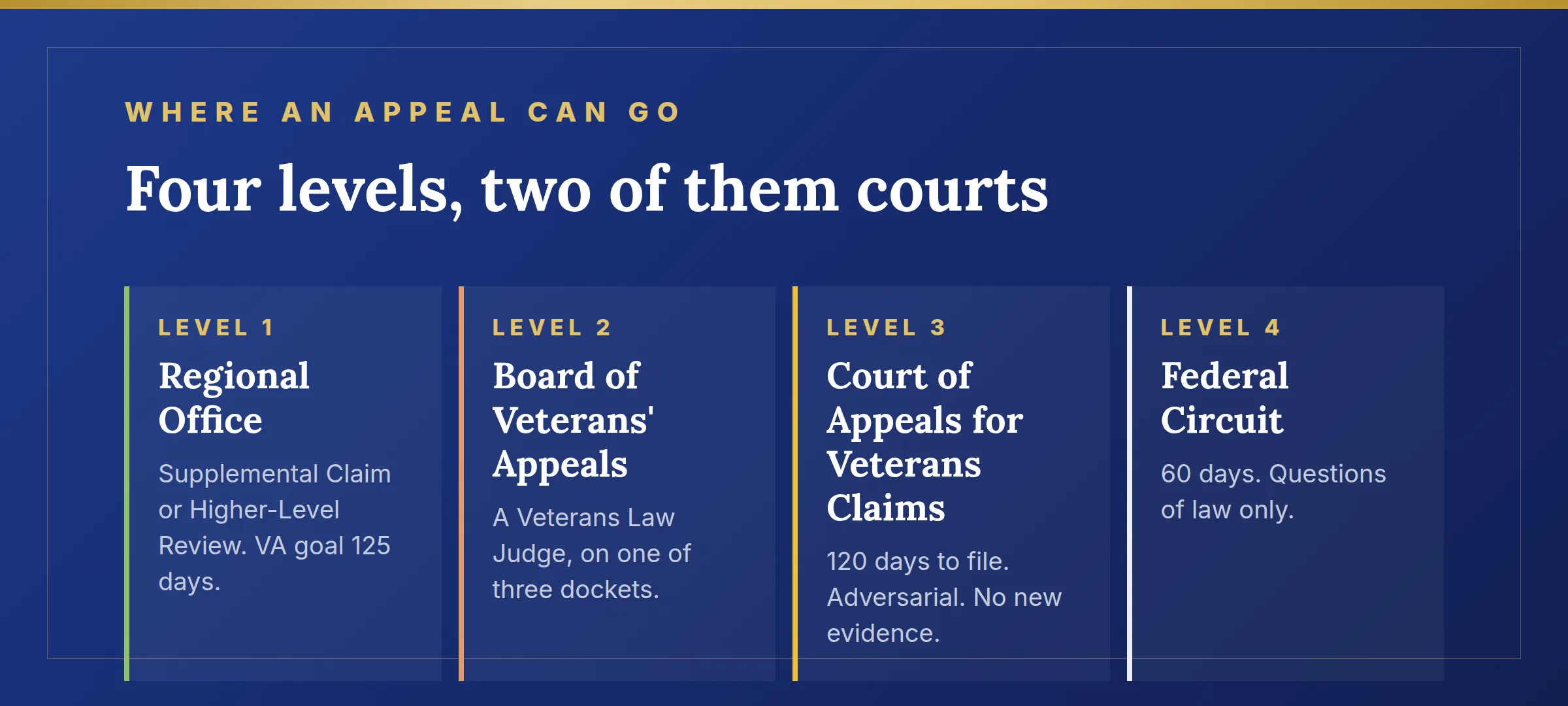
If a claimant receives an adverse decision from the Board of Veterans' Appeals, the administrative process within the Department of Veterans Affairs formally concludes. The next level of appellate review moves outside the executive branch and into the federal judiciary, specifically the United States Court of Appeals for Veterans Claims (CAVC). Established by the Veterans' Judicial Review Act of 1988, the CAVC is an Article I federal court designed to provide independent judicial oversight of final BVA decisions.
Work this step interactively: Phase 3: Escalating to Federal Court in the VA Appeals Navigator.
Initiating the Appeal and the Adversarial Posture
To invoke the jurisdiction of the CAVC, an appellant must file a Notice of Appeal (NOA) with the Court within strictly 120 days of the date the BVA issued notice of its final decision. 38 U.S.C. § 7266(a) and CAVC Rule 4 now run the clock from issuance rather than from the date of mailing, a change Congress made in 2022; some published guidance, including one of the Court's own plain-language pages, still says "mailed." This deadline is statutory and jurisdictional; failure to file within the 120-day window generally results in the immediate dismissal of the appeal, absent extraordinarily rare equitable tolling circumstances. The appellant must also pay a $50 filing fee under Rule 3(f), though this fee can be waived under Rule 24 by submitting a Declaration of Financial Hardship, CAVC Form 4a (redesignated from Form 4 in 2024).
Unlike the non-adversarial, ostensibly pro-veteran claims process at the VBA and BVA, the CAVC is a strictly adversarial forum. The veteran is designated as the Appellant and is actively opposed by a team of appellate attorneys representing the Secretary of Veterans Affairs, designated as the Appellee. Due to the complex legal briefing required, the strict adherence to the Federal Rules of Appellate Procedure, and the fundamentally adversarial nature of the proceedings, it is highly recommended that veterans retain specialized appellate counsel for CAVC litigation rather than attempting to proceed pro se.
Standards of Judicial Review
The CAVC does not conduct a de novo review of the factual record, nor is it permitted to accept any new evidence. Its jurisdiction is strictly appellate, meaning it reviews the BVA's decision based exclusively on the administrative record that existed at the exact moment the BVA ruled. The Court applies specific standards of review depending on the nature of the alleged error, all of which are set out at 38 U.S.C. § 7261:
| Issue on Appeal | CAVC Standard of Review | Level of Deference to BVA |
|---|---|---|
| Statutory / Regulatory Interpretation | De Novo | None. The Court interprets the law independently, affording no deference to the BVA (§ 7261(a)(1)). |
| Factual Determinations | Clearly Erroneous | High. The Court defers to the BVA's fact-finding unless a distinct mistake was made (§ 7261(a)(4)). |
| Explanatory Deficiencies | Adequate Reasons & Bases | None. The BVA must fully articulate its logic under 38 U.S.C. 7104. |
When an appellant alleges that the BVA misinterpreted a statute, a regulation, or a constitutional principle, the CAVC affords no deference to the BVA's legal conclusions. The Court reviews these legal questions de novo, rendering its own independent interpretation of the law from the beginning.
Conversely, the BVA serves as the ultimate fact-finder in the VA system. The CAVC reviews the BVA's factual determinations under a highly deferential "clearly erroneous" standard. Under 38 U.S.C. § 7261(c), the CAVC is statutorily prohibited from subjecting the Board's findings of fact to trial de novo, which forecloses reweighing the evidence or making factual findings in the first instance. A factual finding will only be overturned if, despite some evidence to support it, the reviewing court is left with the definite and firm conviction that a mistake has been committed. If the BVA's factual finding is even marginally plausible based on the record, the CAVC must affirm it.
As previously noted, the BVA is mandated to explain its decisions comprehensively. When the BVA fails to adequately explain why it rejected material evidence favorable to the veteran, or fails to properly analyze a legal theory raised by the record, the CAVC will deem the decision to lack adequate reasons and bases. The vast majority of CAVC remands are predicated on this exact deficiency, as the Court cannot perform its judicial review function if it is forced to guess at the BVA's underlying rationale.
Prejudicial Error, Outcomes, and Future Expansions
The CAVC's review is inherently governed by the rule of prejudicial error, codified in 38 U.S.C. § 7261(b)(2). Even if an appellant successfully demonstrates that the BVA committed a distinct legal or procedural error, the Court will not disturb the decision unless the appellant can prove that the error prejudiced the ultimate outcome of the case. The appellant bears the burden of demonstrating how the outcome would have been different but for the BVA's error.
The CAVC generally issues one of three dispositions. A Remand is the most common outcome, wherein the Court vacates the BVA decision and returns the case to the Board for readjudication because the record is incomplete, the correct legal standard was ignored, or the reasons and bases were inadequate. In fiscal year 2025, per the Court's annual report, 10,449 appeals were filed and 8,758 were disposed of, with dispositions involving a remand accounting for roughly 84 percent. An Affirmance occurs when the appellant fails to meet the burden of persuasion that a harmful error occurred, and ran 4.1 percent of dispositions that year. Reversals are exceptionally rare; the Court will only reverse a BVA decision if it determines that the BVA erred and that the absolute only permissible view of the evidence dictates an outcome in the veteran's favor, leaving no further fact-finding required by the agency. The Court's published tables do not report reversal as a standalone category, because a reversal is entered together with a remand.
The landscape of CAVC jurisdiction is subject to ongoing legislative evolution. Initiatives such as the Veterans Appeals Efficiency Act of 2025, introduced as H.R. 3835 and S. 1992, seek to expand the CAVC's authority to certify class actions, allowing the Court to issue binding rulings on systemic legal errors affecting large classes of veterans whose appeals are still pending at the Board. Such legislation also seeks to grant the Court authority to issue limited remands, directing the Board to address specific legal questions while the Court retains overarching jurisdiction over the appeal. Neither bill has passed either chamber as of August 2026, so this remains proposed legislation rather than current law.
If an appellant is dissatisfied with the CAVC's judgment, they possess the right to appeal to the United States Court of Appeals for the Federal Circuit within 60 days, filed through the CAVC's clerk under 38 U.S.C. § 7292. However, the Federal Circuit's jurisdiction is exceptionally restricted; it can only review questions of law and statutory interpretation, and is strictly barred from reviewing factual findings or the application of law to fact, unless a direct constitutional issue is presented (§ 7292(d)(2)).
Specialized Avenues for Retroactive Effective Dates
While the AMA framework governs the standard lifecycle of an appeal, certain specialized regulations allow for the retroactive assignment of effective dates, circumventing the standard finality of unappealed, historical decisions.
38 CFR 3.156(c): Official Service Department Records
One of the most potent procedural mechanisms in veterans law is 38 CFR 3.156(c), which governs the receipt of official service department records. The general rule dictates that an award of benefits is effective on the date of the claim. However, 3.156(c) establishes a powerful, retroactive exception.
If the VA previously denied a claim, and years later, newly discovered official service department records, such as unit daily logs, previously classified medical records, or missing STRs, are added to the file, the VA is legally obligated to reconsider the prior denial. Crucially, if the VA subsequently grants the claim based in whole or in part on these newly associated service records, the effective date of the award relates back to the date of the original claim, regardless of how much time has passed.
This mechanism does not require the claimant to prove that the VA committed an error during the initial adjudication; it merely requires the introduction of official military records that existed but were physically unavailable to the VA during the prior decision-making process. For veterans who suffered denials decades ago due to missing deployment records or lost clinical files, locating and submitting these records under 3.156(c) can result in massive retroactive backpay spanning years or even decades.
Clear and Unmistakable Error (CUE)
If a decision became final because the one-year appeal period elapsed, and there are no new service department records to invoke 3.156(c), the only remaining avenue to challenge the historical denial is by alleging a Clear and Unmistakable Error (CUE). The authority depends on who made the decision being challenged. A final decision of the agency of original jurisdiction is challenged under 38 U.S.C. 5109A and 38 CFR 3.105(a), and may be raised at any time. A final decision of the Board is challenged under 38 U.S.C. 7111 and 38 CFR 20.1400 through 20.1411, filed as a motion directly to the Board rather than as a claim at the regional office. Filing in the wrong forum wastes the motion.
The evidentiary and pleading burden for a CUE is extraordinarily high. A CUE is not merely a disagreement with how the VA weighed the evidence, nor is it an avenue to introduce new private medical opinions. To successfully plead a CUE, the claimant must demonstrate two critical prongs. First, either the correct facts, precisely as they were known at the time of the decision, were not before the adjudicator, or the statutory and regulatory provisions extant at the time were incorrectly applied. Second, the error must be absolutely outcome-determinative; meaning, if the error had not been made, it is undebatable that the claim would have been granted. The regulation itself calls it "a very specific and rare kind of error," and provides that "if it is not absolutely clear that a different result would have ensued, the error complained of cannot be clear and unmistakable."
A CUE must be plead with extreme specificity, pointing to the exact legal or factual error made at the time of the decision. If a CUE is successfully established, the previous decision is legally revised, and the effective date relates back to the date of the original claim. Due to the legal precision required, attempting a CUE without specialized legal counsel is highly ill-advised, as poorly drafted CUE motions are routinely dismissed for failing to meet the rigid pleading standards.
The Spectrum of Representation and the Benefit of Competent Counsel
The transition from the administrative VBA process to the appellate BVA and CAVC environments highlights the indispensable nature of competent legal representation. The VA system is fundamentally bifurcated into two distinct domains. The VBA operates in a procedural environment driven by the M21-1 manual, where initial claims and basic increases are processed. Conversely, the BVA and CAVC operate in a highly technical legal environment driven by statutory interpretation, constitutional due process, and complex federal precedent. Navigating these disparate environments requires selecting the appropriate advocate for the specific stage of the claim.
Work this step interactively: Who can help, and with what in the VA Appeals Navigator.
State and County Veterans Service Officers
Free state and county Veterans Service Officers (VSOs) are one available resource for veterans filing initial claims, routine increases, or straightforward secondary conditions. State-sponsored entities, such as the Missouri Veterans Commission (MVC), deploy highly trained VSOs across nearly every county to provide counseling and claims assistance free of charge. These professionals are accredited by the VA, possess access to the VA's Benefit Delivery Network, and are trained to navigate eligibility criteria for service-connected compensation, non-service-connected pensions, and ancillary benefits like Aid and Attendance. Organizations like the MVC also offer periodic estate planning clinics staffed by volunteer attorneys, which produce very basic documents such as simple wills, living wills, and advance directives; the volunteers are not usually estate planning attorneys, and the clinics are not a substitute for a plan drafted for a specific family. Veterans can locate the nearest Missouri VSO office through the Commission.
Accredited Attorneys and Claims Agents
When an initial claim is denied, or when a case requires sophisticated appellate strategies such as traversing the BVA dockets, litigating at the CAVC, or pleading a complex CUE, the specialized skills of accredited attorneys and accredited claims agents become critical. Federal law heavily regulates these advocates; they are legally recognized by the VA, required to undergo character and fitness reviews, mandated to complete continuing legal education, and are bound by stringent ethical standards. A representative's accreditation can be confirmed directly through VA's accreditation search.
Accredited representatives can also obtain access to the veteran's digital claims file through VA's representative systems, which allows them to monitor exam requests, review C&P examination results before a rating decision is finalized, and identify the specific procedural errors necessary to win a Higher-Level Review or draft a compelling BVA brief. That access is not automatic or uniform: it requires separate approval, specific equipment, and credentialed authentication, and many accredited representatives do not hold full access.
The financial framework surrounding accredited legal representation provides robust protection for the veteran. Pursuant to 38 CFR 14.636 and 38 U.S.C. 5904, accredited attorneys and claims agents operate almost exclusively on a contingency fee basis. They charge no upfront fees, and they only collect a percentage of the retroactive back pay if, and only if, the appeal is successful. They cannot charge fees for future monthly benefits, nor can they legally charge a fee for services performed before VA issues notice of its initial decision on the claim. The regulation sets the reasonableness boundaries by presumption: a fee not exceeding 20 percent of past-due benefits is presumed reasonable, and a fee exceeding 33 and one-third percent is presumed unreasonable. Where VA pays the representative directly out of past-due benefits, the agreement must be wholly contingent and capped at 20 percent. This contingency model aligns the financial interests of the attorney directly with the veteran; the representative is highly incentivized to exhaustively search the C-File for 3.156(c) or CUE opportunities to maximize the retroactive award. Data underscores the efficacy of this specialized representation; in a single month (April 2026), accredited claims agents and attorneys secured over $128 million in retroactive benefits for the veteran community.
Accreditation and What It Actually Governs
Accreditation is a legal status, and what it governs is authority before VA rather than competence. An accredited attorney, claims agent, or VSO representative can be appointed as representative of record, access VA's representative systems, sign and file documents on the veteran's behalf, and appear before the Board. A consultant who is not accredited cannot do those things, however knowledgeable that consultant is.
Many veterans get real help outside that system: assembling service and medical records, organizing evidence, preparing for a C&P examination, or sorting out which benefit to pursue in the first place. That work has value, and it is not what accreditation is about. What it cannot do is stand in for a representative of record once the case reaches a step that requires one, such as filing a Notice of Appeal at the CAVC, pleading CUE, or briefing a legal argument under 38 U.S.C. 7104. Fee arrangements made outside 38 CFR 14.636 also sit outside VA's fee-review framework, so read any agreement carefully and understand what you are paying for before you sign it. The useful question is not who to avoid; it is who is authorized to take the next step your claim actually needs.
Conclusion
Navigating an adverse VA disability claim decision requires significantly more than a rudimentary understanding of VA forms; it demands a highly strategic, long-term approach to administrative and federal appellate law. Veterans must act defensively by immediately securing their complete C-File via FOIA requests to understand the precise nature of the denial and uncover hidden procedural errors. With the clock ticking on the AMA's one-year continuous pursuit deadline, a calculated choice must be made between filing a Supplemental Claim supported by robust, new medical evidence, or requesting a Higher-Level Review to expose a procedural Duty to Assist error committed by the agency.
When the bureaucratic constraints of the VBA fail to yield a just result, escalating the claim to the Board of Veterans' Appeals forces a de novo review bound by the rigorous constitutional and statutory requirements of 38 U.S.C. § 7104. Should the Board err in its legal application or fail its explanatory duties, the adversarial theater of the Court of Appeals for Veterans Claims provides a vital federal backstop to correct clear errors and legal misinterpretations.
Given the dense regulatory frameworks governing evidence, the strict jurisdictional deadlines, and the sheer complexity of mechanisms like CUE and the retroactive power of 38 CFR 3.156(c), pursuing appellate action requires specialized knowledge. By leveraging the appropriate echelon of counsel and by understanding the distinct evidentiary burdens inherent in each appellate lane, veterans can systematically dismantle adverse decisions and secure the maximum compensation authorized by law.