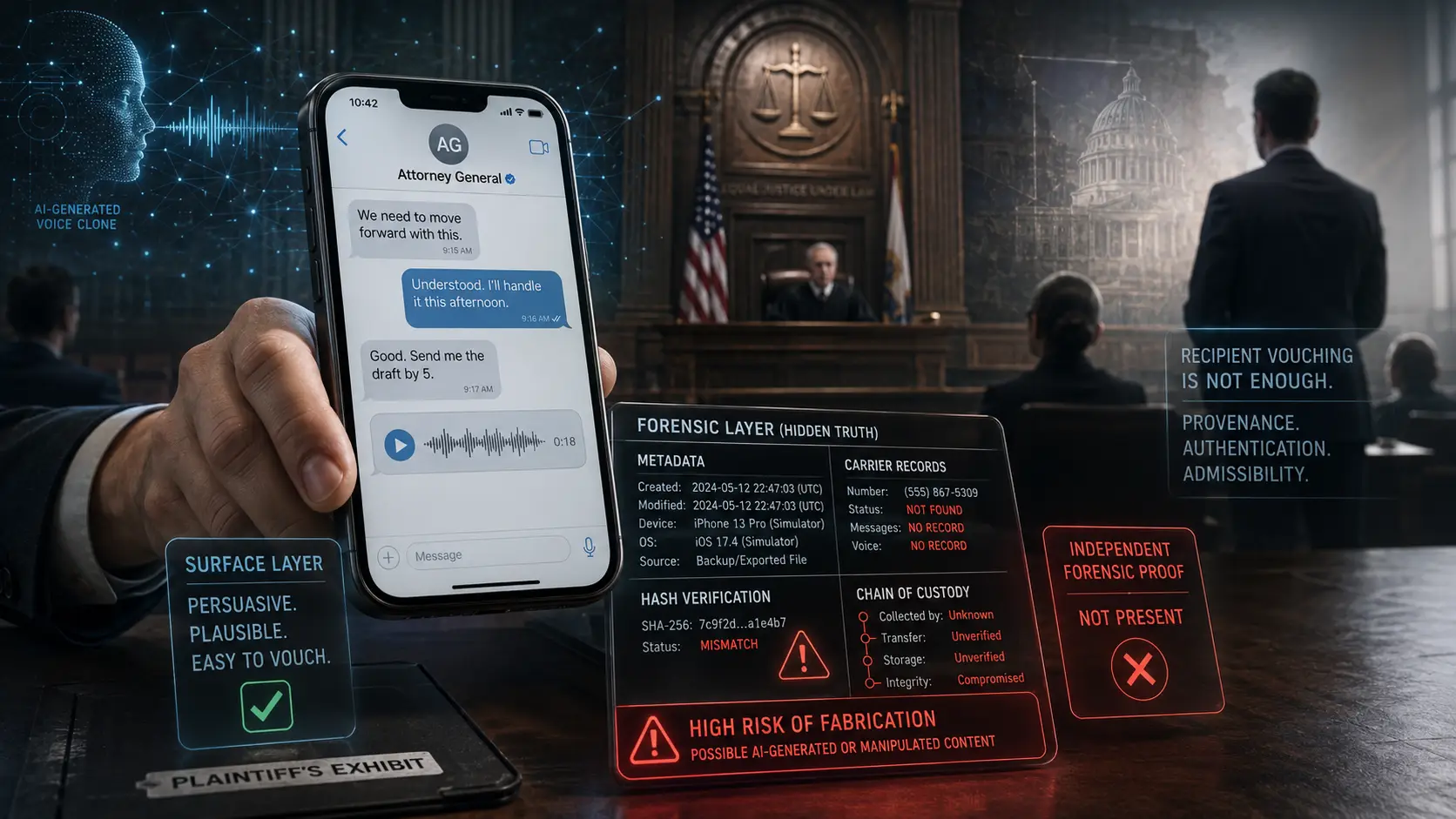
Choi could have walked those same texts into a Missouri courtroom under the rule announced in State v. Harris, 358 S.W.3d 172 (Mo. Ct. App. 2011). Harris allows a text message to be authenticated when the recipient testifies that she “regularly receives messages from the author from that number” (prong 3), or when the message contains “something distinctive about the content, such as a personalized signature, that identifies the author” (prong 4). Choi was the recipient. She had the workplace knowledge to fabricate distinctive content. Her sworn testimony, standing alone, would have satisfied the rule on its face.
That is the structural problem with Harris in 2026. Prongs 3 and 4 rely on the proponent vouching for the evidence she has produced. When the proponent is also the recipient, and when generative AI has collapsed the cost of fabrication to near zero, vouching has stopped functioning as an authentication safeguard. It functions as a license.
This article argues three points. First, the Harris prongs that depend on proponent vouching no longer carry the evidentiary weight they did in 2011. Second, Missouri trial courts have the doctrinal authority, under State v. Hosier, Kappel v. Prater, and Inman v. Bi-State Development Agency, to address that problem today, without waiting for appellate or institutional reform. Third, the proper procedural sequence places the initial forensic burden on the proponent, where it belongs.
I. The Vouching Pattern
Choi is the cleanest example because the proponent was a sworn officer of the court, the fabrication was unsophisticated, and the disciplinary record is public. The pattern is not unique to prosecutors. It recurs in three settings.
Melissa Sims, a nurse in Florida, was arrested in 2025 after her ex-boyfriend showed police text messages she had supposedly sent in violation of a no-contact order. She had not sent them. She spent a day or two in jail before bonding out, then carried the criminal case for eight months and through a jury trial before clearing her name. The screenshot the officers saw at the arrest stage looked like every other text-message screenshot. The ex-boyfriend’s sworn statement that the texts had come from her was the foundation that put her in a cell.
In the family-court matter handled by NGH Group and reported in late 2025, a mother in a contested custody dispute submitted two audio recordings purporting to capture the father making threatening statements. Forensic analysis identified that both files had been recorded on an iPhone and that their metadata showed creation dates ten days after the mother had subscribed to ElevenLabs’ paid voice-cloning service. The court ordered seizure and examination of her devices. She confessed. Until the forensic exam, the mother’s testimony that the recordings captured the father’s voice was the foundation she offered.
Three different settings, one common pattern. The proponent is the recipient. The proponent vouches for the evidence she produced. The fabrication is exposed only because some third party (a carrier, a forensic examiner, an ElevenLabs account record) preserved corroborating data that contradicted the vouching. In each case, the cost of obtaining that corroboration was substantial. The carrier subpoena in Choi required a disciplinary tribunal. The forensic exam in the NGH Group matter cost the contesting parent thousands of dollars. The Sims case took eight months and a jury trial to resolve.
That is the operating reality. Vouching admits the evidence. Disproof requires forensic work that the wronged party may not be able to afford or access in time.
II. Harris in Its Original Context
Harris was decided as a matter of apparent first impression by the Eastern District in 2011. The court held that the content of text messages on a phone “is more properly analogous to a personal letter and those rules of admissibility should be applied.” 358 S.W.3d at 175. The proponent must “present some proof that the messages were actually authored by the person who allegedly sent them.” Id. at 176. The court emphasized that the requirement “should not be an unduly burdensome requirement and can be satisfied by circumstantial evidence,” and identified four acceptable forms of proof: an admission by the author that he wrote the messages, an admission that he controls the relevant phone, recipient testimony of regular messaging from that number, or distinctive content identifying the author. Id.
Two of those prongs depend on something other than the proponent’s vouching. Prong 1 requires the alleged author’s admission. Prong 2 requires the alleged author’s admission of phone ownership and control. Both prongs put the operative testimony in the mouth of the person against whom the evidence is offered. Hostile admissions are durable foundation.
Prongs 3 and 4 are different. Prong 3 places the operative testimony in the mouth of the recipient. Prong 4 places it in the message itself, with the proponent vouching that the content is distinctive enough to identify the author. Both prongs make sense when the recipient is independent of the dispute and the distinctive content cannot plausibly be fabricated. In 2011, those assumptions held. Texts came from physical devices that had physical custody chains. Fabricating a multi-message thread required either device access or technical skills most litigants did not have. Distinctive content (workplace inside jokes, family references, particular turns of phrase) was hard to manufacture without the underlying knowledge.
Harris took those assumptions for granted. The opinion does not address what happens when the recipient is the adverse party with motive to fabricate, or what happens when distinctive content can be replicated by a language model trained on prior message exports. Those questions were not before the Eastern District in 2011. They are before Missouri trial courts now.
III. The Premise Has Collapsed
Three technologies inverted the cost curve underlying Harris.
Voice cloning. ElevenLabs, Resemble AI, and several open-source equivalents can produce a convincing clone of a target voice from thirty seconds of source audio. The synthesis is fast enough to run on consumer hardware. The NGH Group matter shows the family-court application: a spouse with access to prior recordings of the other parent can produce “threatening” audio in an afternoon and submit it as evidence the next day.
Text-style mimicry. The spouse, sibling, business partner, or close friend who has read thousands of messages from the alleged author knows what those messages look like. That familiarity is exactly what Harris was designed to credit as authentication. It is also exactly what makes spoofing trivial. A former spouse can replicate her ex-husband’s text patterns from memory after years of marriage. When technology is convenient, free consumer AI tools close any remaining gap. Drop seven to ten message samples into the prompt, ask the model to reproduce a target message in the author’s style, and the output arrives in six minutes.
Contact-label manipulation. This requires no technical sophistication at all. Choi demonstrates the operation. A user changes the contact name associated with a phone number in her own device’s address book, sends or generates messages from any number, and produces screenshots showing the messages as if they originated from the chosen contact. A prosecutor with no technical background can do this in under five minutes.
Each of these techniques attacks the same vulnerability in Harris. Prong 3’s “regular messaging from that number” assumes the recipient’s testimony about the number is meaningful. With contact-label manipulation, the number on screen has no necessary connection to the actual sender. Prong 4’s “distinctive content” assumes the content is hard to fabricate. With text-style mimicry and access to prior exports, distinctive content is the easiest part to forge.
The federal trajectory recognizes this inversion. The Advisory Committee on Evidence Rules has prepared a draft Rule 901(c) that, once an opponent makes a prima facie showing of AI fabrication, would require the proponent to prove the exhibit is more likely than not authentic. Proposed Fed. R. Evid. 901(c) (June 10, 2025 Standing Comm. Agenda Book). Louisiana enacted Act 250 imposing a counsel duty of “reasonable diligence” in verifying authenticity, with attorney sanctions for violation. La. Code Civ. Proc. arts. 371, 1551 (2025). California’s Judicial Council was directed to develop court rules for AI-generated evidence claims by January 1, 2026. Cal. SB 970 (2024). Federal trial courts have begun excluding AI-altered evidence under existing rules. Mendones v. Cushman & Wakefield, No. 23CV028772 (Cal. Super. Ct. Alameda Cnty. Sept. 9, 2025) (terminating sanctions for deepfake exhibits); State v. Puloka, No. 21-1-04851-2 KNT (Wash. Super. Ct. King Cnty. Mar. 29, 2024) (excluding AI-enhanced video under Frye); Matter of Weber, 2024 N.Y. Slip Op. 24258 (Sur. Ct. Saratoga Cnty. 2024) (excluding expert testimony based on undisclosed Copilot use).
Missouri’s authentication doctrine has not yet engaged with this development. The doctrinal evolution happens through trial-court gatekeeping and appellate opinions. Both vectors are available.
IV. The Proof-of-Negative Trap
Why does proponent vouching fail in the AI era? The opponent cannot prove a negative. Proving that the alleged author did not send a message requires affirmative evidence that the message never existed, evidence the opponent does not control and a burden that is impossible. The opponent can show only the absence of corroboration: no carrier-side record, no corresponding outgoing record on the alleged sender’s device, no third-party witness, no provenance chain. Each absence is circumstantial. None of them, alone or together, conclusively establishes that the message was fabricated.
Under a rule that accepts the proponent’s vouching as foundation, the proponent’s direct testimony beats the opponent’s circumstantial absences every time. The opponent’s best showing (“the carrier has no record of this message transiting the network”) proves only that the message did not travel through the carrier’s infrastructure, or that no one preserved such evidence. It does not prove the alleged author did not send it through some other channel. The proponent’s vouching survives. The evidence comes in.
That structural asymmetry produces a predictable economic outcome. The wronged party must spend thousands of dollars on forensic investigation, expert testimony, and motion practice to chip away at a foundation the proponent built for free with her own sworn statement. The Sims case cost the wronged party an arrest, eight months of criminal exposure, and a jury trial. The NGH Group case cost the contesting parent a forensic engagement and substantial counsel time. The Choi case required a disciplinary tribunal’s subpoena power before the fabrication came undone. In each case, the wronged party paid in time, money, or freedom for the privilege of contradicting a foundation that should not have been accepted in the first place.
The fix shifts the burden. The proponent must produce affirmative evidence of authenticity beyond her own vouching. Carrier records. Device records. Hash verification. Chain of custody. When the proponent produces affirmative provenance, the foundation is sound. When she cannot, the foundation fails. The opponent’s role contracts to its proper scope: showing the absence of provenance, which is something an opponent can do.
Missouri law already supports this allocation. The trial court has gatekeeping authority under State v. Hosier, 454 S.W.3d 883, 896 (Mo. banc 2015), to require the proponent to lay the foundation, including authenticity, before evidence is admitted. The Missouri Supreme Court clarified in Kappel v. Prater, 599 S.W.3d 189, 195 (Mo. banc 2020), that “foundation” means a showing that the evidence is what it “purports to be.” The Eastern District in Inman v. Bi-State Development Agency, 849 S.W.2d 681, 684 (Mo. Ct. App. 1993), held that the best-evidence rule is implicated when fabrication is alleged, because in that circumstance the terms of the original are directly in dispute. Each of these doctrines is older than Harris. None requires appellate or legislative action to invoke. Each one, read together, supports a Missouri trial court’s authority to demand affirmative provenance evidence from the proponent when fabrication is plausibly alleged.
V. The Procedural Sequence the Doctrine Supports
The procedural challenge to a vouching-only foundation should not be filed before the proponent has had the opportunity to produce her case. It should begin after the first round of discovery has closed, when the proponent has committed to her exhibits and her foundation testimony.
Step one. The challenger serves a production demand. The demand should specifically request the original electronic source file, device-level forensic images of the proponent’s device, all associated metadata, and (for messages) carrier-side records covering the period of the alleged communications. The demand cites Inman and State v. King, 705 S.W.3d 650 (Mo. Ct. App. E.D. 2024), for the proposition that when fabrication is alleged and the original is accessible, the original must be produced.
Step two. The challenger demands that the proponent deliver an expert forensic review of the proffered evidence. The review should address device acquisition methodology, hash verification, metadata analysis, and chain of custody. The proponent who cannot produce a forensic review, or who produces one with methodological gaps, has failed to satisfy Kappel‘s “purports to be” standard. The proponent who delivers a competent forensic review has discharged the initial burden, and the inquiry continues.
Step three. The challenger reviews the proponent’s forensic submission and decides whether a counter-forensic examination is necessary. In many cases the proponent’s submission will reveal the gap on its face: no carrier records, no hash verification, no chain of custody, or metadata anomalies the proponent’s expert glossed over. In those cases the challenger may proceed directly to the foundational hearing without commissioning additional work. In cases where the proponent has produced a competent and apparently complete forensic submission, the challenger must decide whether to commission an independent examination of the underlying device.
Step four. If the challenger commissions an independent examination, the next move is securing the device. The challenger moves the court for an order compelling production of the original device for inspection by a neutral forensic examiner or by the challenger’s own expert. The demand is supported by Inman and by the best-evidence framework articulated in State v. McDaniel, 300 S.W.3d 274, 280–81 (Mo. Ct. App. 2009).
Step five. The court holds the foundational hearing. The Missouri equivalent of a Federal Rule of Evidence 104 hearing is a preliminary hearing on the admissibility of evidence, often conducted within a motion in limine or as a preliminary determination by the trial judge. The trial court is responsible for deciding preliminary questions of witness qualification, the existence of a privilege, and admissibility of evidence, the same allocation Federal Rule 104(a) provides. For conditional-admissibility questions where relevancy is conditioned on fact (analogous to FRE 104(b)), Missouri courts may hold pre-trial foundation hearings. When justice requires or the matter involves sensitive admissibility issues, Missouri judges hear arguments outside the presence of the jury, mirroring the FRE 104(c) approach. At the hearing, the proponent presents her authentication evidence including the forensic review. The challenger cross-examines and, if a counter-forensic examination was commissioned, presents the independent expert’s findings. The court rules on admissibility.
This sequence has three operational virtues. It places the initial forensic burden on the party with the most direct knowledge of the evidence and the most direct interest in its admission. It reserves the challenger’s forensic spend for the cases where the proponent’s submission is genuinely contested. It produces a record that can be evaluated by the trial court at a single hearing rather than across multiple piecemeal objections at trial.
The sequence is consistent with the federal direction in proposed Rule 901(c), which contemplates exactly this kind of pretrial allocation of burdens. Proposed Fed. R. Evid. 901(c). It also tracks the procedural pattern in Mendones, where the court conducted its own threshold inquiry into the metadata before issuing an order to show cause, Puloka, where the trial court held a Frye hearing on the AI-enhanced video before excluding it, and Weber, where the court ran the same Copilot prompt on three computers and got three different answers as the basis for excluding the expert’s testimony. Each of those cases produced an exclusion because the trial court used existing gatekeeping authority to inquire affirmatively rather than accept the proponent’s vouching.
VI. What the Missouri Trial Court Can Do Today
The argument so far reduces to a doctrinal proposition. Missouri trial courts do not need new authority to address AI-fabrication challenges. The existing combination of Hosier, Kappel, and Inman already supplies it. The trial court has discretion to require affirmative provenance evidence from the proponent when fabrication is plausibly alleged. The trial court has authority to convene a threshold authentication hearing. The trial court has authority under the best-evidence rule to demand production of the original device when fabrication allegations make the original’s terms directly disputed.
Harris remains good law for its original use case. The Eastern District in 2011 addressed text messages from a flip-phone era when the recipient was independent of the dispute and distinctive content was hard to fabricate. That fact pattern still exists. Most contemporary text-message authentication disputes still resolve under Harris prongs 1 and 2 or under prongs 3 and 4 in their original sense, where the recipient is a neutral or third-party witness and the distinctive content is genuinely beyond the proponent’s capacity to fabricate.
Harris’s scope contracts only in the adverse-proponent scenario. When the recipient is the party against whom the alleged author is litigating, and when fabrication is supported by some prima facie showing of motive, means, and opportunity, Harris prongs 3 and 4 do not satisfy Kappel‘s definition of foundation without affirmative provenance evidence in support. The trial court reads Harris alongside the later authority in Kappel and the earlier authority in Inman, neither of which the Harris court had occasion to consider. Harris remains intact for its original use case. The later authority does the work the 2011 court could not have anticipated needing.
VII. Closing
Choi, Sims, and the NGH Group case illustrate a single pattern. The proponent vouches for evidence she has produced. The vouching is accepted at face value because the rule of authentication, read in its most permissive form, does not require more. The fabrication is later exposed, sometimes at great cost to the wronged party, sometimes too late to prevent real harm. In Choi’s case the disciplinary tribunal caught it. In Sims’s case the wronged party was arrested, briefly jailed, and required eight months and a jury trial to clear her name. In the NGH Group case a contested custody proceeding was almost concluded on the strength of cloned audio.
Missouri trial courts will see this pattern. Many already have. The question is whether the trial court will accept the proponent’s vouching as foundation or require something more. The doctrinal materials supporting the second course exist in Missouri case law. The procedural sequence to invoke them exists in ordinary discovery practice and in the inherent gatekeeping authority of the trial court. The federal trajectory is moving the same direction.